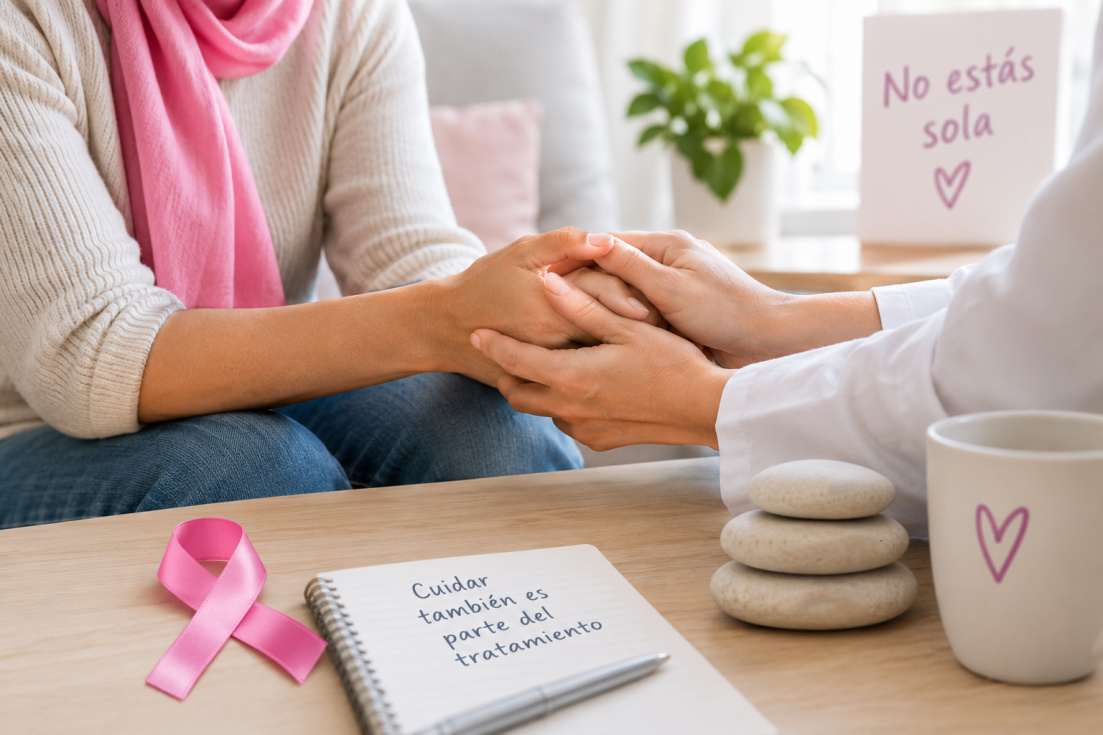
A psychologist at the association Amadem, Luisina Daives, has argued that emotional care should form part of the response to breast cancer, writing that psychological support helps patients handle the changes the illness and its treatments bring. Her opinion piece was reported by Benissa Digital and picked up by several local outlets in the Marina Alta region of Spain.
Daives said a diagnosis of breast cancer can upend a person's life, forcing them to confront a new reality marked by uncertainty and by treatments that may provoke fear, sadness, anger and worry. According to Benissa Digital, she cited figures from the Spanish Society of Medical Oncology (SEOM) estimating 38,318 new cases in Spain during 2026.
Why it matters
The psychologist's central point is that distress after a cancer diagnosis is not automatically a sign of mental illness. Fear and sadness can be ordinary responses to an extraordinary situation, she said. What matters, in her view, is how a person manages their thoughts, emotions and behaviour, and whether they feel able to cope with the resources they have.
At the same time, she warned that anxiety and depression can emerge during the process, and that symptoms may worsen for people who were already living with mental health difficulties before their diagnosis. That is why she considers it important to attend to psychological wellbeing from the moment of diagnosis and through the different stages of treatment.
The stakes are practical as well as emotional. Daives noted that a person's emotional state shapes how they look after themselves. When distress grows, it can become harder to eat a balanced diet, stay physically active or rest properly.
How exhaustion and low mood feed into daily habits
Daives described a pattern in which fatigue leads people to cut back on physical activity, while emotional strain disturbs sleep and pushes everyday choices toward whatever feels easiest. During cancer treatment, she said, these patterns can overlap with physical symptoms and the demands of therapy itself.
Paying attention to such shifts, she added, helps patients and those around them recognise when more support may be needed.
Her advice to seek help was direct: people should not be afraid to ask for it. Support from mental health professionals, she wrote, can provide tools for facing the circumstances and can make the road less heavy and less painful.
The psychologist's broader conclusion is that emotional care deserves a place within the attention given to people with breast cancer. Recognising one's own needs and seeking support when necessary, she argued, can help patients meet the challenges the illness presents.
Benissa Digital reported that Daives made her case in an opinion article, and the message was echoed by Teulada Moraira Digital, Calp Digital, Denia Digital and Xàbia al Día, which ran pieces on the same theme. Denia Digital framed it as Amadem reasserting the case for psychological support in breast cancer, while Xàbia al Día focused on the importance of asking for help after a diagnosis.
The reporting did not specify any new programme, funding or clinical guidance from Amadem. The intervention was a public argument for treating mental health as part of cancer care rather than a separate concern.
What to watch: whether local health services and patient groups in the region take up the call and build psychological support more explicitly into breast cancer pathways.